
When Edgar Degas is mentioned, the mind often turns toward dancers. There are rehearsals, crowded stages, ballet slippers, mirrors and figures caught between movement and rest. His art is closely associated with the modern city and with the private discipline of the studio. Yet the subject of nature never disappeared from his work.
Edgar Degas landscapes occupy a quieter place in his reputation, but they offer a revealing view of his artistic imagination. Hills, fields, wooded spaces and shorelines gave him a different set of problems. There were no dancers whose gestures had to be observed, no stage arrangement to organize and no interior filled with social tension. Instead, he had distance, weather, irregular ground and the difficult task of making open space hold the viewer's attention.
Degas did not approach landscape in quite the same way as the Impressionist painters most often associated with outdoor painting. He was not simply interested in recording a passing view in bright natural light. His landscapes could be dark, compressed, unstable, or strangely atmospheric. Some seem less like descriptions of a place than records of looking itself.
Beyond a fixed center
One of the most striking features of Degas's outdoor work is the absence of a single commanding subject. In a work such as Landscape, the eye may move across the surface rather than settle immediately on a figure, building, or dramatic event.
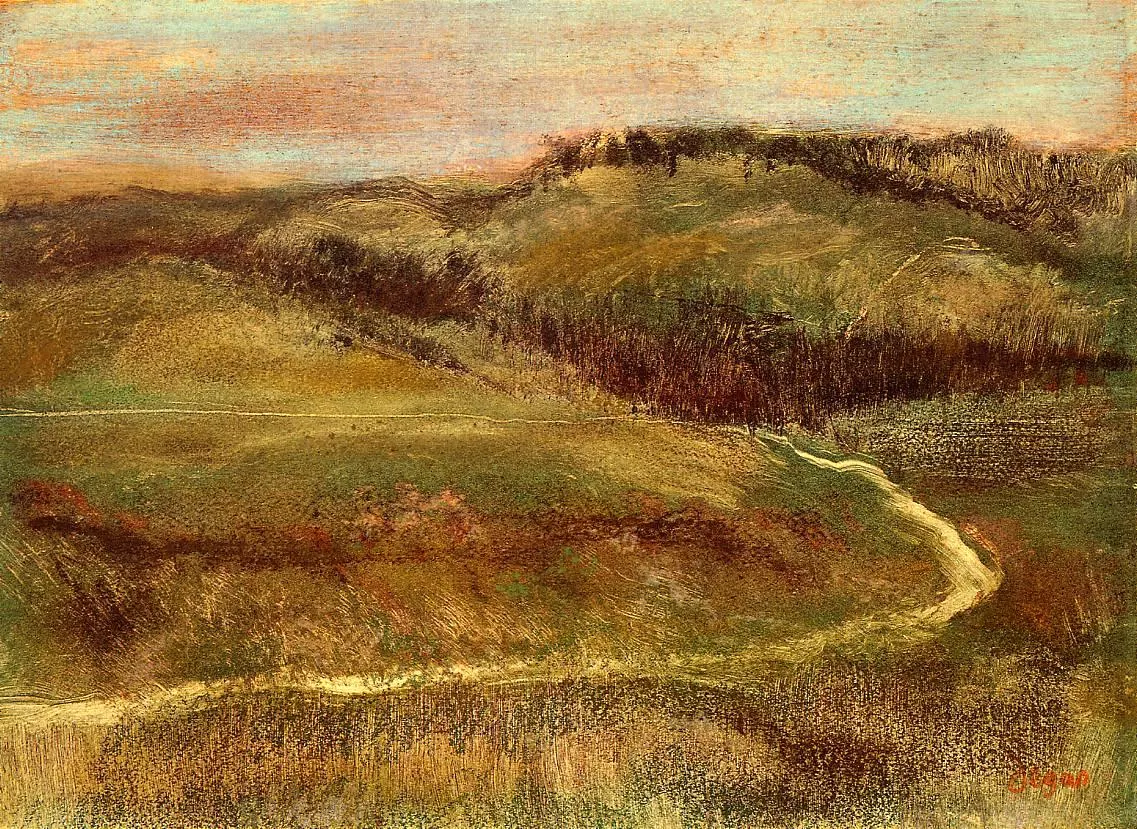
This changes the pace of viewing. A dancer usually establishes a human scale. Even when the body is cropped or placed awkwardly at the edge of the composition, the viewer understands the scene through posture, gesture and physical presence. A landscape offers fewer such instructions. The gaze travels through bands of land, patches of vegetation, distant forms and openings in the sky.
The composition may therefore feel less stable. A path can lead nowhere obvious. A hillside may interrupt the view rather than open it. A dark mass of trees can conceal as much as it reveals. These are not necessarily shortcomings. They may be part of Degas's interest in the way a landscape is encountered in fragments, while walking or turning one's head.
The countryside is not presented as a perfectly ordered panorama. It is experienced as a sequence of visual impressions.
Hills and the problem of distance
Hills are especially useful for understanding Degas's treatment of space. They create depth, but they also interrupt it. A distant ridge can establish a horizon while remaining close enough in tone and shape to merge with the middle ground. The result is a landscape in which distance feels uncertain.
In Landscape with Hills, the receding terrain becomes more than a geographical detail. The hills organize the movement of the eye and establish a rhythm of rising and falling forms. Their contours may appear soft, while darker passages in the foreground hold the composition in place.
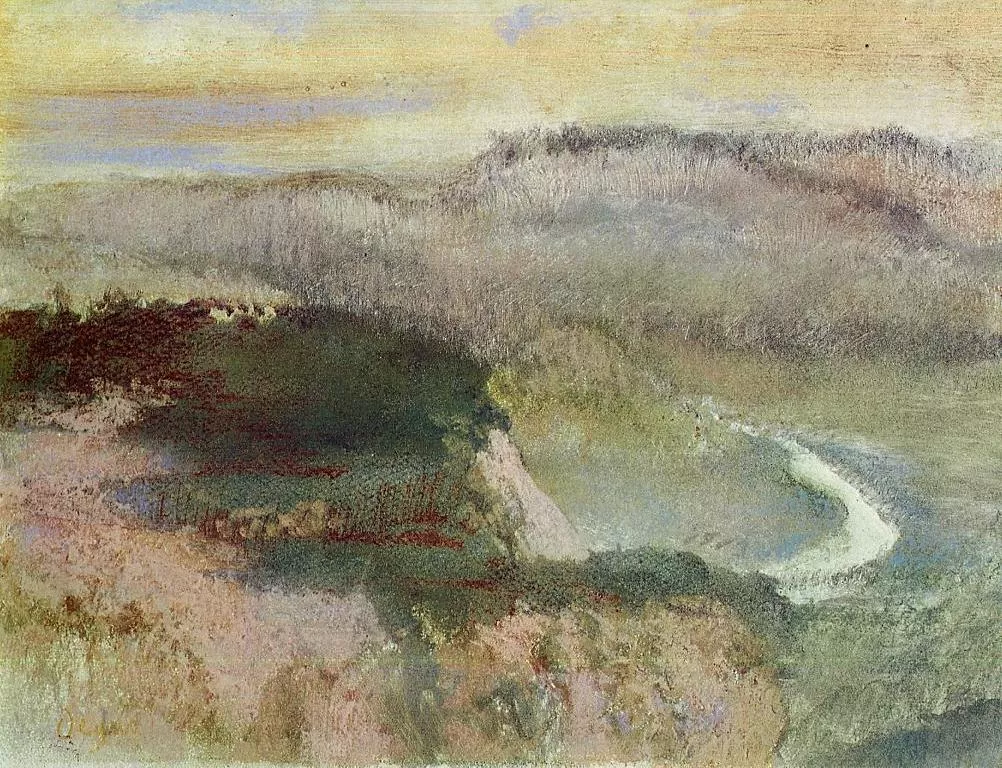
Perhaps the most compelling aspect of such a scene is its restraint. There is no theatrical climax. The land simply continues, folding into the distance. Yet that quiet progression can make the viewer more aware of small changes in color and surface. A muted green beside a brown slope, a pale passage beneath a darker ridge, or a thin band of sky can carry much of the painting's emotional weight.
Degas's interest in distance also separates these works from a straightforward study of local scenery. The landscape becomes a test of perception. How much can be suggested with a few broad shapes? When does a hill remain solid and when does it dissolve into atmosphere?
The rural world and the moving gaze
Degas's landscape subjects were connected with places beyond the crowded spaces of Paris. Normandy and other rural regions appear in accounts of his landscape practice and the Orne provides one example of the kind of setting that allowed him to study irregular terrain and open air.
Landscape on the Orne can be approached through this relationship between place and movement. A river landscape is never entirely still. Water introduces a horizontal flow, while banks, trees and fields create interruptions along its course. The viewer's gaze may follow the river, then move outward toward the land around it.
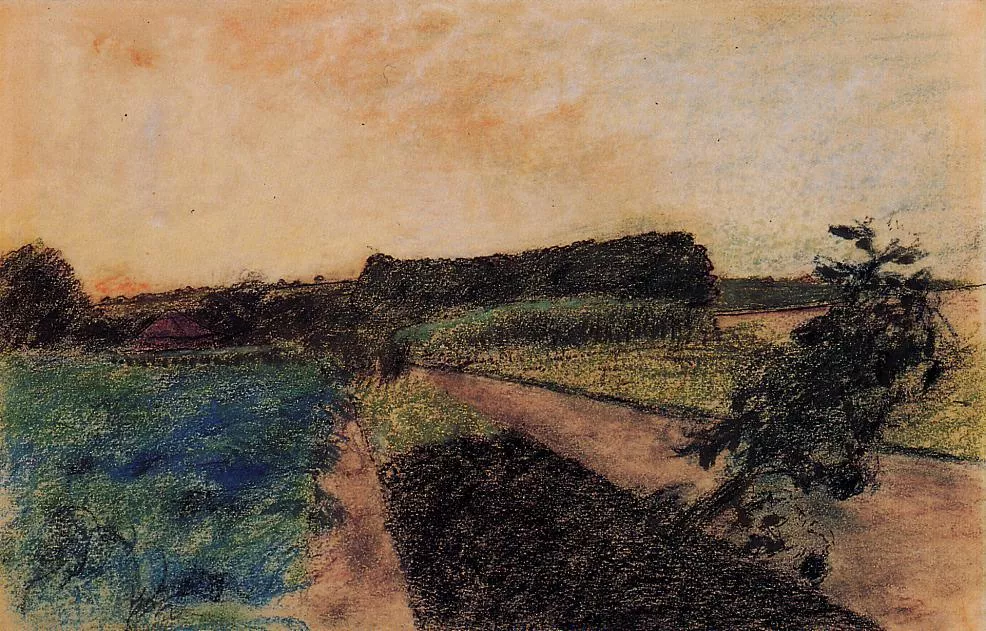
The painting's interest may lie less in identifying every feature than in sensing how the scene is arranged for the eye. A river can act as a route through the composition. A line of vegetation can block that route. A bend in the land can redirect attention.
This is close to a broader concern in Degas's art. His compositions often seem to reflect a body in motion, even when the subject itself is momentarily still. In a landscape, that movement belongs to the viewer. One looks across the terrain, pauses at a dark shape, moves toward the horizon and returns to the foreground.
The countryside becomes a space through which perception travels.
Coastlines, weather and unstable surfaces
The sea offered Degas a different kind of visual challenge. Unlike a hill or a building, water has no fixed outline. Its appearance depends on wind, light, tide and the angle from which it is seen. A shoreline can establish a boundary, but the water beyond it remains in constant visual motion.
In Landscape by the Sea, the open coastal setting may be read as an exercise in withholding detail. The sea does not need to be described wave by wave. A broad field of color, a broken edge, or a shift between pale and dark passages can suggest its presence.
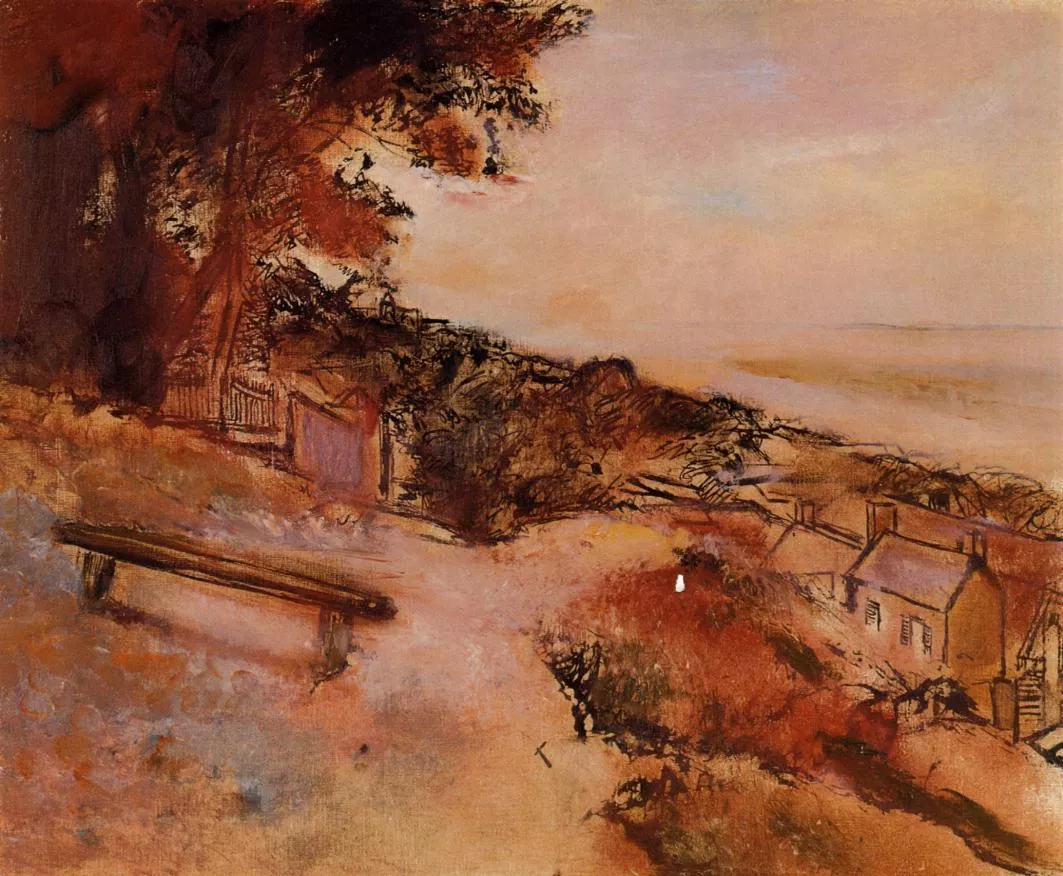
The same principle appears in Rising Tide, where the title places emphasis on change. The tide is not merely a feature of the scene. It is an event unfolding across the surface of the water and along the shore.
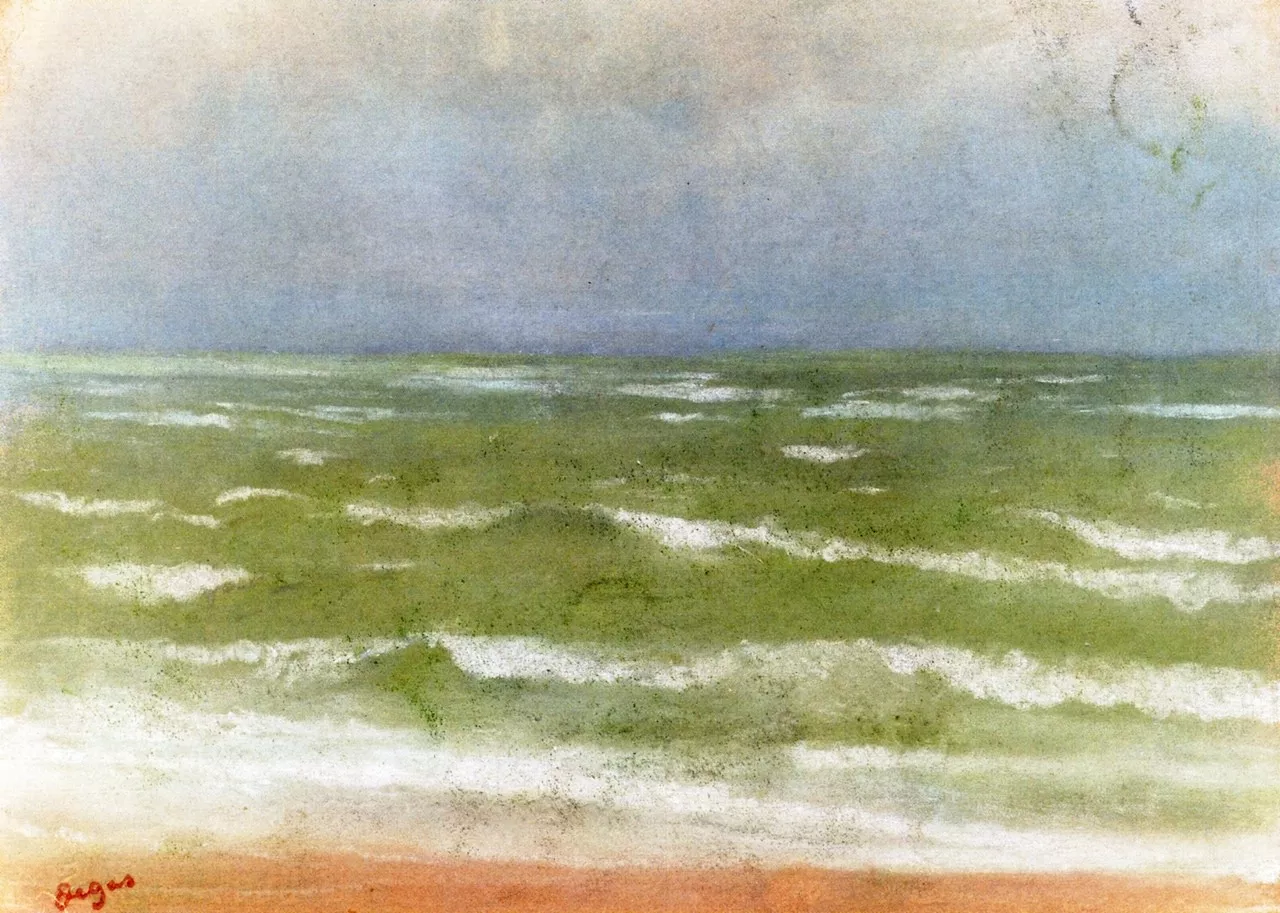
Such subjects also help explain why Degas's landscape work can feel experimental. Museum discussions of his monotypes show that he explored ways of producing atmospheric effects through oil paint applied to a plate and transferred to paper. He sometimes worked further into the printed image with pastel. This process allowed dark tones, blurred transitions and unexpected textures to become central elements of the image.
The technique mattered because it suited the subject. A landscape shaped by mist, dusk, or changing weather does not always benefit from precise contours. A smudged passage can suggest distance more effectively than a carefully drawn line. A dense dark area can feel like a forest, a cloud bank, or a mass of wet earth without being fully resolved.
A darker and more inward landscape
Degas's landscapes are not always peaceful in the conventional sense. Their quietness can contain tension. A wooded area may feel closed rather than open. A low horizon may create a sense of pressure. A sunset may reduce the world to a few heavy zones of color instead of offering a radiant display.
This darker atmosphere connects some of Degas's landscapes with the broader nineteenth-century interest in rural mood and expressive natural forms. Yet his approach remains distinctive. He was less concerned with presenting nature as a grand moral subject than with testing the limits of composition, medium and vision.
The landscape could be cropped, compressed, or made difficult to read. Its very uncertainty became part of the experience.
That quality is important when considering Degas beyond the familiar images of ballet. His dancers are often observed in moments of imbalance, interruption, or incomplete action. His landscapes can produce a related sensation through different means. A path is cut off. A hill obscures the horizon. The sea extends beyond the frame. The viewer is given enough information to enter the scene, but not enough to master it at once.
The quiet side of Degas
Landscape was not the dominant subject of Degas's career and it would be misleading to treat it as though he abandoned the studio for a sustained life of plein-air painting. Its importance lies elsewhere. These works show him returning to nature as a field of experiment, especially when conventional pictorial order no longer seemed sufficient.
The hills, rivers and coastlines in his art offer a slower encounter than the theatrical world for which he is best known. They ask the eye to move without a clear narrative. They make atmosphere, surface and distance carry the composition. They also reveal how Degas could find movement in apparently still things, from the gradual recession of a hillside to the shifting edge of a tide.
Looking at these works today, one may notice how little they insist on themselves. They do not always announce a subject. They allow forms to fade, darken, or remain unresolved. Their silence is active rather than empty.
In that sense, Edgar Degas landscapes are not a minor footnote to the better-known paintings of dancers. They are another way of understanding his attention to vision, movement and the unstable boundary between what the eye sees and what the mind completes.